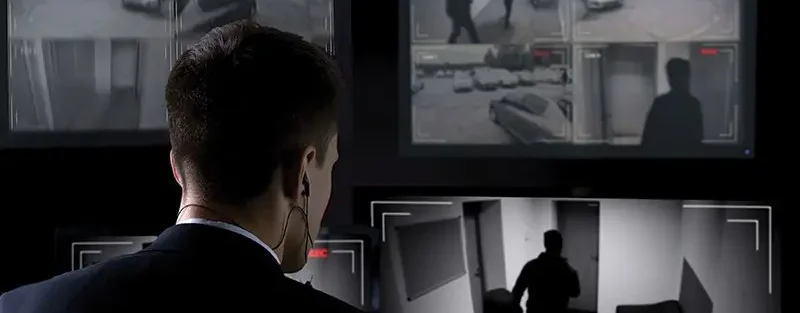
Remote video monitoring pairs security cameras with off-site operators who watch live feeds, flag unusual activity, and act in real time. Instead of recording footage for someone to review after a break-in, a monitoring center verifies what the camera sees and responds while the person is still on the property.
This kind of coverage runs on the cameras already installed at a site, paired with a monitoring center that's staffed day and night, watching live feeds for Houston-area construction sites, warehouses, apartment communities, and parking areas.
The Three Steps Between a Flagged Clip and a Call to Police
A monitored camera system runs through the same sequence every time something triggers it, whether that's a person cutting through a loading dock after hours or a car circling a parking garage twice.
Detection. Cameras equipped with motion or video analytics scan the feed continuously and flag movement that falls outside the pattern set for that camera, a person near a fence line after closing, for example, rather than a tree branch moving in the wind.
Verification. An operator at the monitoring center pulls up the flagged clip alongside the live feed, confirms whether it shows an actual person or vehicle, and rules out false alarms before anyone is dispatched.
Response. Once an operator confirms a real threat, they can speak directly to the person through an on-site speaker, trigger an alarm or lights, and contact police or an on-site patrol while the activity is still happening.
Four Places Theft Shows Up First: Yards, Docks, Common Areas, Lots
On a construction site, cameras usually cover the equipment yard and the material laydown area, the two spots where tools, generators, and copper wiring disappear fastest once they're off the property. An operator watching those feeds overnight can catch someone loading a trailer before the crew arrives and finds the yard empty.
Warehouses add a second layer: dock doors and the perimeter fence line. Camera placement around blind spots like stairwells and dock aprons matters as much as the monitoring behind it, which is why security camera installation and monitoring tend to get planned together rather than bolted on separately.
Apartment and multifamily properties lean on monitored cameras at the pool, mailroom, and parking structure, the spots where property managers field the most complaints about trespassing and vehicle break-ins after dark.
Surface lots and parking garages are where the cycle moves fastest: an operator watching a parking camera can see someone trying door handles across a row of cars and step in with an audio warning before they reach the fourth or fifth vehicle.
The Gap Between Patrol Rounds is Exactly What a Camera Feed Closes
A guard on a fixed patrol covers a property on a schedule, checking a loading dock or stairwell every so often rather than watching it without interruption. A monitored camera system covers the same ground without that gap, since the feed doesn't step away between checks.
The tradeoff runs the other way too. An operator watching a screen can't physically intervene on-site the way a guard can: checking an ID at an entrance, opening a gate, or walking a tenant to their car.
Why a Patrol Already on Rounds is Often the Response to What a Camera Catches
A construction site or warehouse covered by mobile patrol rounds benefits from adding monitored cameras overnight, when foot traffic through a gate is the clearest sign something's wrong. The camera catches and verifies the activity the moment it starts, and a patrol unit already rotating through the property on 7 to 10 minute rounds can be the one confirming it in person.
Properties that only need daytime coverage, like a retail storefront with staff on-site during business hours, usually get more value from cameras monitored after close than from a round-the-clock patrol add-on.
Frequently Asked Questions
Do I need monitored cameras if I already have an on-site guard during business hours?
Usually the gap is after hours, not during them. A guard covers the property while they're on shift; monitored cameras pick up coverage once the gate locks and no one's walking the site anymore.
Can an older camera system be connected to a monitoring center, or does it have to be new equipment?
It depends on whether the existing cameras can output a live feed a monitoring center can pull from. Some older analog setups need an upgrade first; many newer IP camera systems can be connected as they are.
What happens when an operator sees someone who turns out to have a legitimate reason to be there?
The operator notes it as a false alarm and the feed keeps running. Nothing gets escalated unless the same alert keeps repeating, which usually points to a camera angle that needs adjusting rather than an actual problem.
Is remote monitoring worth it for a single small parking lot, or only for larger properties?
Lot size matters less than how often the lot sits unattended after dark. A small lot next to a closed office or retail strip can justify monitoring; a lot that's staffed or well-lit with regular foot traffic may not need it.
If an operator spots someone on camera, what actually happens next?
The operator verifies the activity first, then responds based on what they see: an audio warning through an on-site speaker for someone who shouldn't be there, or a call to police if the situation looks more serious.
Request a Quote for Remote Video and Alarm Monitoring
Request a quote for remote video and alarm monitoring for your Houston-area property, and a City Security Services rep will go through which cameras and coverage hours fit your site.
Need a quote for your Houston property? Contact City Security Services and our team will walk you through the options.