
On This Page
- 9 min read
Secure Your Property With Mobile Patrols in Houston
We deliver fast, visible overnight deterrence and quicker response across the Energy Corridor, East End, and Galleria—free on-site assessment included; where’s your after-hours gap?
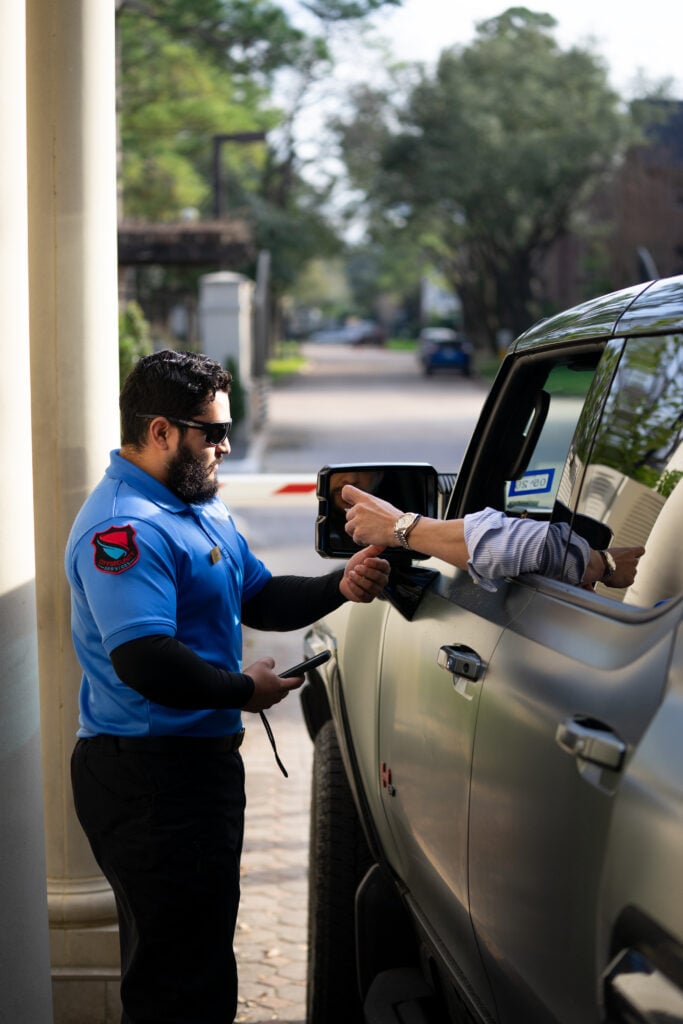
Houston’s After‑Hours Gap You Can’t Ignore
You asked where the after-hours gap is—watch what happens once lights go out. In Westchase, we see an office park look calm at 9:15 p.m., until a car idles in the far corner by the retention pond. Across the East End, a warehouse yard has a fence snipped behind the rail spur at 2:10 a.m.; the camera pings, but nobody can verify. Big footprints. Thin coverage.
From midnight to 5 a.m., your lots sit empty, lights cycle, and shadows stretch across 1,200 feet of fence line. Five gates, three docks, and two side alleys mean ten ways in—and only one person on-call. Response times drift when crews are spread across Beltway 8 and the Ship Channel. That’s exactly when risks cluster. So how do you cover that window without full-time posts?
What Mobile Patrols Do — Houston Edition
So how do you cover long perimeters and many entry points at night? Mobile patrols are marked security vehicles that conduct scheduled and randomized drive-throughs and foot checks across your Houston sites. Each round is GPS (Global Positioning System) logged, with QR/NFC checkpoint scans at hot spots, and officers handle lockups, unlocks, and alarm response. We design routes that span single facilities or multi-property portfolios from the East End to Katy, so you get visible deterrence, real verification, and on-the-spot intervention without paying for full-time posts.
What do you see? Time-stamped photos, GPS breadcrumbs, and exception reports when something’s off. We send Daily Activity Reports (DARs—shift summaries), incident reports with annotated images, and monthly heat maps highlighting high-risk windows along I‑10 and 610. Property managers tell us they need concise, actionable notes: door pulls completed, lights out at dock 4, chain repaired on gate B—no fluff. Whether you oversee three retail pads near the Galleria or ten warehouses along the Ship Channel, our reporting aligns to your asset list and escalation tree.
Here are the core capabilities Houston facility teams rely on when they add mobile patrols.
- Randomized Deterrence: Variable routes and timing make stops unpredictable, disrupting routine scouting and opportunistic theft.
- Perimeter Coverage: Rapid vehicle sweeps and foot checks across lots, alleys, docks, and fence lines.
- Rapid Response: A patrol car verifies alarms on-site in minutes—faster than remote monitoring and call-outs.
- GPS/Photo Proof: Time-stamped logs, checkpoint scans, and clear incident photos document every visit and action.
- Integrated Reporting: Shift summaries, exception notes, and monthly heat maps tailored to your property and contacts.
Why Foot Posts and Cameras Alone Miss Houston Realities
We see the blind spots every week. In Greenspoint, a single foot guard can’t cover a 40‑acre campus with five docks, two alleys, and a perimeter that runs behind detention ponds. Cameras help, but CCTV (closed‑circuit television, video feeds) still needs someone on-site to verify what motion alerts actually mean. By the time a remote operator calls, the person checking door handles is gone. In the Energy Corridor, parking decks create dark corners that a lone post visits once an hour at best. Long perimeters plus delayed verification equals opportunity. And that’s exactly where mobile units change the math.
Shift changes create predictable holes. At 11:00 p.m., the relief officer is stuck at the gatehouse while loading docks on the south side sit unchecked for 25 minutes. Multi-building campuses around Briarforest and Memorial need door pulls across ten entrances; a single post prioritizes lobbies and misses stairwells and service corridors. Then there’s contractor access after hours—one wrong badge, and a propped door stays open until morning. The friction shows up in your timeline: report filed at 11:52, supervisor notified at 12:10, vendor arrives at 12:40. Too slow for a five-minute theft.
Here are the pain points Houston operators mention when cameras and a single post are asked to do it all.
- Too Many Access Points: Multiple gates and docks create blind intervals no single post can patrol.
- Slow Escalation: Remote alarms still demand on-site verification, adding minutes while suspects slip off property.
- Cost Creep: Adding foot posts multiplies payroll but barely increases perimeter coverage across spread-out sites.
- After-Hours Gaps: Shift changes and breaks create predictable windows that repeat nightly and attract opportunists.
The Stakes Rise With Scale and Timing in Houston
Risk spikes when your rhythm slows. In the East End industrial corridors, night shipments hit between 1:00 and 4:00 a.m., just as weekend staffing thins and dock doors cycle. Along the I‑10/610 logistics belts, trailers sit staged for morning loads, making seals, kingpins, and copper wiring easy targets. Near the Galleria, retail pads and parking decks stay publicly accessible late, so loitering and break-ins cluster after close. Turnovers and quiet hours concentrate exposure into a narrow window. If nobody is visibly circling, opportunists test doors, scan for lifted gates, and work fast. Minutes matter. Documentation does too.
Now add a portfolio lens. Your warehouse on Clinton Drive, a retail strip off Post Oak, and a school near Spring Branch all share the same after-hours curve: quiet weekends, late deliveries, and thin staffing. Incidents rarely stay isolated; a converter theft on Friday often precedes a Monday copper pull two miles away along 610. When managers juggle multiple radios and vendor lists, response slows and reporting fragments. A mobile unit that roams your sites—on a shared route weeknights, dedicated on weekends—keeps a single playbook, one escalation tree, and consistent proof across addresses.
Watch for these patterns—they tell us when to tighten routes and add visits.
- Multi-Site Portfolios: Dispersed assets share one risk curve; a pattern at one site predicts others.
- Seasonal Surges: Peak construction and retail seasons shift exposure later at night and onto weekends.
- High-Value Targets: Copper, catalytic converters, tools, trailer seals, and rooftop air-conditioning units draw organized crews.
- Public-Facing Lots: Late-night access invites loitering, dumping, and vehicle break-ins between closing and pre-dawn.
Vehicle Patrols That Close Your After-Hours Gap
Those public-facing lots are exactly where mobility wins. A marked patrol car compresses response from 20–30 minutes to 3–7 because the unit is already circulating nearby. One vehicle extends coverage equal to two or three static posts by sweeping perimeters, pulling doors, and clearing dark corners on every pass. And you get proof, not promises: GPS (Global Positioning System) breadcrumb trails, QR (quick response) / NFC (near-field communication) checkpoint scans, and time-stamped photos that show where we were and what we did. Instead of paying for multiple posts, you use one mobile unit to create visible deterrence, rapid verification, and clean documentation across several buildings or pads. Fewer blind spots. Faster action.
Picture a 1:40 a.m. alarm at a warehouse off Clinton Drive. We roll in six minutes, verify a cut fence, and stay on-scene until your vendor re-secures the gate—photos included. On campuses, we escort late staff to parking within two minutes of a call and log the route. Construction sites get 10-minute fence-line sweeps and tool trailer checks; retail lots get hot-spot passes near dumpsters and mailrooms every round. Each stop is documented the same way every night: checkpoint scan, photo, notes, and a clear “all normal” or “exception found” tag in your Daily Activity Report (DAR).
Here’s how we deploy mobile patrols in Houston—step by step—so you see measurable results within 30 days.
Step 1: Site Assessment: Walk the property; map gates, docks, alleys, lighting, and hot spots; confirm after-hours schedules and vendor access.
Step 2: Post Orders: Define randomized routes, alarm triggers, documentation standards; set visit cadence and foot/vehicle split with clear escalation.
Step 3: Patrol Onboarding: Equip officers with GPS logging, QR/NFC checkpoints, and report templates; brief on property rules, contacts, and safe engagement.
Step 4: Live Operations: Execute rounds, verify alarms, document actions; communicate with supervisors and HPD (Houston Police Department) when needed.
Step 5: Optimize: Review incidents and key performance indicators; adjust routes and timing to reduce recurrence and meet service-level targets.
Vehicle patrols complement foot posts and CCTV (closed-circuit television) by filling gaps—door pulls, perimeter sweeps, and alarm verification—for a layered, faster, and fully documented security posture on Houston campuses.
Marked vs Unmarked: Pick the Right Presence in Houston
Use this quick comparison. Community perception and Texas DPS (Department of Public Safety) rules matter—so we match visibility to your policies before rollout.
| Option | Visibility | Best For | Key Benefits | Watch-outs in Houston |
|---|---|---|---|---|
| Marked patrol vehicle | High: decals, lightbar, uniformed presence | Retail lots, auto dealers, schools, campuses | Strong deterrence, tenant reassurance, brand presence | Avoid police-like imagery; follow Texas DPS branding rules |
| Unmarked patrol vehicle | Low: blends in for surveillance and intel | Recurring break-ins, investigations, copper theft patterns | Catch-in-the-act verification; discreet evidence gathering | Manage optics with HOAs (homeowner associations); align policies |
| Hybrid mix (marked plus unmarked) | Medium: deterrence plus periodic low-profile checks | Mixed portfolios, phased rollouts, seasonal risk shifts | Balance deterrence and intel; flexible by shift | Use data to adjust mix by site and season |
Build trust in Midtown and The Heights by notifying residents, publishing patrol windows, and honoring HOA (homeowner association) guidelines. We document respectful engagements and noise policies. Next, see how the right presence changes ROI on construction, parking, and residential sites.
Houston ROI: Mobile Patrol Wins for Construction, Parking, and Residential
You asked how the right presence changes ROI—here’s what it looks like across common Houston properties. Skim the three scenarios, then we’ll scale to warehouses and campuses next.
- Construction Sites: Midtown and Medical Center projects get randomized night patrols, 10-minute fence-line sweeps, and pre-dawn tool trailer checks. Our construction site security Houston locks gates and documents seals—often avoiding $5K copper hits with one timely pass.
- Parking Lots & Garages: Galleria and Downtown garages get marked passes, lighting and CCTV (closed-circuit television) checks, and 2–5 minute late-worker escorts. Choose parking lot security services Houston to cut break-ins and curb $1.5K–$3K converter losses before morning.
- Residential Communities & HOAs: In Westchase and The Heights, low-profile perimeter sweeps, pool and amenity lockups, and quiet-hours enforcement reduce calls. Our residential security guards Houston keep optics friendly while documenting trespass trends for board action.
Houston’s Industrial Playbook: Warehouses, Manufacturers, and Commercial Campuses
You’ve seen the wins for construction, parking, and residential. Now let’s scale to higher‑complexity sites—warehouses, manufacturers, and campuses—and show how patrols cut risk while controlling budget. Implementation steps next.
- Warehouses & Logistics: East End yards and the I‑610 loops get dock-door pulls, trailer seal checks, and yard sweeps. Our warehouse security services Houston document tamper points, deter loitering, and verify alarms before dispatch to cut shrink and delays.
- Manufacturing Facilities: Port-adjacent plants need perimeter and hazardous-area sweeps plus contractor verification after hours. Our manufacturing security Houston pairs safety checks with access control, logging eyewash, lockout/tagout signage, and door pulls so you meet policy and prevent overnight incidents.
- Commercial Campuses: Energy Corridor office parks get multi-building door pulls, parking-deck sweeps, and late-worker escorts. Our commercial security services Houston TX balance deterrence and optics with marked passes, lighting checks, and photo-verified reports tenants can trust.
- Property Managers: Multi-site portfolios benefit from shared routes on weekdays and dedicated units on peak weekends. Our property management security standardizes post orders and delivers monthly KPI (key performance indicator) dashboards, heat maps, and incident photos across addresses for board-ready reporting.
Fast Houston Rollout: Timeline, Post Orders, and Cost Controls
You want standardized post orders and board-ready reporting—so how do we launch in Houston? Simple: inquiry, site walk, draft, patrols. If you call by 10 a.m., we can usually conduct a same-day site walk and start first patrols that night for a single property. Multi-site portfolios typically launch within 24–48 hours, depending on access. The sequence is tight: 20-minute planning call, on-site walkthrough, risk map and hot spots, draft post orders, checkpoint setup, then a 30-day pilot. You’ll get KPI (key performance indicator) targets up front—incidents per week, response time, hot-spot coverage—so you can judge ROI fast.
To move quickly, we need four things: a site map (basic layout with gates, docks, stairwells), access details (codes, keys, or a lockbox location), a live contact tree (who we call at 1 a.m.), and any alarm or camera tie-ins (so we verify video before dispatch). If you have these ready, startup is hours, not days. No map? We’ll sketch one during the walkthrough. No lockbox? We’ll stage a temporary one. Alarm integrations with your vendor can take 1–3 days; everything else is same-day. Bottom line: we don’t wait on perfect paperwork to get patrols circling.
Now, let’s control spend without losing coverage. We use four levers you can tune monthly, and even weekly during peak-risk windows.
- Right-Sized Frequency: Concentrate visits 10 p.m.–4 a.m.; ease back when heat maps cool.
- Hybrid Coverage: Use vehicle sweeps nightly; add short foot checks at stairs, docks, and mailrooms.
- Route Design: Cluster neighboring sites to share a patrol car and split costs cleanly.
- Data-Driven Adjustments: Drop low-yield stops; double pass frequency where incidents repeat.
Houston Patrol Post Order Checklist
We adjust routes by data; now lock it into writing. Copy/paste this Houston-ready checklist into your post orders, then tweak by site. Next up: compliance and community alignment.
- Access Points: List gates, docks, stairwells, roof hatches; note lock types.
- Patrol Intervals: Randomize within windows; set scheduled rounds by zone and priority.
- Lighting & Doors: Record outages, flicker, missing lenses; document unsecured entries for work orders.
- Alarm Response: Verify on-site, capture photos/video, time-stamp, and follow escalation tree.
- Parking & Towing: State visitor rules, escort options, citation steps, vendors, and tow rotation.
- Incident Reporting: Include timestamps, GPS checkpoints, photos, narrative, and distribution list.
- HPD Liaison: List Houston Police contacts, district, case numbers, and when to call.
- Tenant Notices: Quiet-hours policy, amenity lockups, expected response times, and contact channels.
Compliance, Licensing, and Community Trust in Houston
You’ve already set tenant notices and quiet-hours; now let’s lock them to Texas rules and neighborhood norms. We operate under the Texas Department of Public Safety’s Private Security Program (DPS—the state regulator), and we encourage you to verify any vendor’s active license and insurance certificates. Marked vehicles are clearly identified as private security and avoid police-like imagery, lightbar colors, or insignia restricted by DPS policy. Before rollout, we match presence to setting—marked at commercial sites, softer profile near homes—and document alignment with HOA (homeowner association) policies, property rules, and property authorization letters (permission to engage trespassers and request HPD, Houston Police Department, support). Compliance first. Visibility second.
Do quick due diligence up front and you’ll avoid headaches later. Ask for three items: DPS license status (screenshot or link to the state lookup), current insurance COIs (certificates of insurance) for general liability and workers’ comp, and training records relevant to your site. We standardize evidence handling—time-stamped photos, GPS logs, and chain-of-custody notes—so your reports stand up in claims or HR (human resources) reviews. Neighborhood norms matter in Houston: Midtown tolerates marked presence but prefers no sirens; The Heights expects headlights down and no idling near bungalows; the Museum District wants quiet corridors by 10 p.m. Curious about frequency or armed vs. unarmed? Check the FAQs next.
Midtown, Museum District, The Heights: publish quiet hours, dim lightbars after 10 p.m., angle headlights away from homes, avoid idling, and list patrol paths. Share a contact number and response times so residents know what to expect.
Houston Patrol FAQs
Quiet hours and patrol paths are set—good start. Now, here are fast answers; if your site’s unique, call us for specifics.
- How soon can patrols start?: Single sites launch same night after a 20‑minute call and site walk. Portfolios go live in 24–48 hours. Access codes/lockbox, site map, and contacts speed everything.
- Can one vehicle cover multiple sites?: Yes—cluster 2–5 properties within 3–5 miles. We schedule 5–15 minute stops and randomize passes. If incidents spike or travel exceeds routes, we add a dedicated unit.
- Do you work with existing cameras?: Absolutely. We tie into CCTV/VMS (cameras/video management) alerts for video verification, then dispatch the patrol already near your site. Fewer false alarms, clearer evidence, faster resolution.
- Marked or unmarked—how to decide?: Use the comparison: marked for deterrence in retail/campuses; unmarked for surveillance patterns. We match HOA (homeowner association)/tenant optics and Texas DPS (state regulator) requirements, adjust by season.
- Will patrols disturb residents?: We run quiet-hours routes: dim lightbars after 10 p.m., angle headlights away, no idling. Near homes, we favor short foot checks and publish windows and contacts.
Ready to Secure Your Houston Property Tonight?
You’ve seen how we run quiet-hours routes—dim lightbars, no idling, resident-friendly foot checks—now put that precision to work with fast deployment, randomized patrols, and GPS-logged rounds from our Houston-local team. Book a free 20-minute site assessment and get a draft post order.
Houston Patrol Experts — Trained, Transparent, 24/7
Before you tap Request Mobile Patrol Quote — Houston, here’s what that buys you. We staff Houston-trained officers who complete our in-house academy tailored to property types—hospitality, education, banking, and commercial. Then we write site-specific post orders and back every round with GPS (Global Positioning System) breadcrumbs, time-stamped photos, and real-time reporting you can open on your phone. Need coverage at 1:30 a.m.? We run 24/7, with local supervisors adjusting routes the moment a hot spot flares.
You won’t guess where we were or what we did—you’ll see it. Daily activity reports, incident photos, and monthly heat maps show door pulls, dock checks, and outcomes by shift. We operate under Texas DPS (Department of Public Safety) licensing, carry proper insurance, and coordinate with HPD (Houston Police Department) when escalation is appropriate. The result is simple: faster verification, fewer after-hours surprises, and post orders that evolve with your risk—not a static binder.
Get Expert Help
Let's discuss your test plan