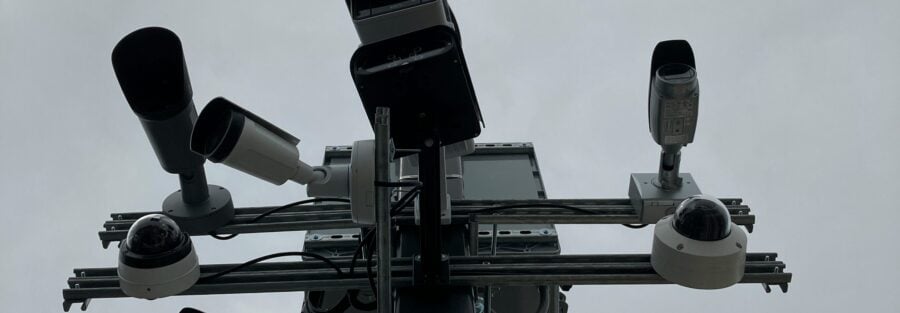
The Houston Business Owner’s Guide to Commercial Security Camera Installation
Security cameras are one of the most visible and effective investments a Houston business can make in physical security. But purchasing cameras and installing them correctly are entirely different undertakings. A poorly planned CCTV system — with wrong placement, inadequate resolution, or insufficient storage capacity — creates a false sense of protection rather than actual deterrence or evidence capability.
This guide covers everything a Houston business owner needs to know before installing a commercial surveillance system: system types, camera placement strategy, resolution and storage specifications, cost considerations, and what professional installation includes.
Why Commercial CCTV Systems Differ From Consumer Products
A wide range of camera hardware exists, from consumer smart cameras available at hardware stores to professional commercial surveillance systems built for continuous operation. For a business, the differences are operationally significant.
Commercial surveillance systems are engineered for 24/7 continuous operation, not occasional home monitoring. They offer higher resolution imaging, superior low-light and wide dynamic range performance, longer-rated hardware lifecycles, and integration capability with access control panels, alarm systems, and professional monitoring platforms.
Consumer-grade cameras fail in demanding lighting conditions like parking lot entrances and bright-backlit lobbies, provide minimal local storage before overwriting recent footage, and are not designed to integrate with enterprise security platforms. A consumer camera capturing a break-in may produce footage of such poor quality that it supports neither prosecution nor insurance claims.
For any business managing customer or employee footage, commercial-grade CCTV equipment is the appropriate standard. City Security Services provides security surveillance camera installation in Houston using commercial-grade hardware with professional system design and configuration from site survey through final handover.
Step 1: Define Your Coverage Goals Before Selecting Hardware
Before choosing a single camera model, define precisely what you need your system to accomplish. Common goals for Houston businesses include:
Documenting every person who enters and exits the facility with identification-quality facial capture. Monitoring parking areas and vehicle access lanes for theft, vandalism, and incident documentation. Recording activity at cash handling points, safes, or premium merchandise displays. Covering warehouse aisles, dock doors, and freight staging areas. Providing evidentiary footage for incident investigations and insurance claims.
Each goal drives different placement decisions, field-of-view requirements, and resolution specifications. Defining goals before hardware selection prevents the most expensive camera installation mistake: buying a system that captures a lot of footage of the wrong things.
Step 2: Camera Placement Strategy
Placement is where most Houston business camera installations produce disappointing results. The four most common mistakes cost owners money without delivering usable footage.
Mounting cameras too high
Cameras installed at ceiling height capture a wide-angle overhead view that is useful for confirming that an event occurred but rarely captures the facial detail needed for identification. For evidence quality, cameras mounted between 8 and 10 feet aimed at a 30 to 45 degree downward angle toward the subject’s face produce identification-grade footage at entry points and high-value zones.
Pointing cameras into backlit areas
A camera aimed directly at an entrance where natural daylight creates a halo behind subjects will produce silhouettes, not identifiable images. Wide dynamic range (WDR) camera technology or complementary lighting solves this — but only if the backlit condition is identified and addressed during design, not after installation.
Creating dead zones between shelving or equipment
A camera at one end of an aisle covers clearly in one direction but leaves a blind spot behind it. Cameras positioned at aisle intersections with appropriate field of view eliminate these coverage gaps entirely.
Neglecting exterior approaches
Many Houston businesses achieve solid interior coverage but have no cameras covering the parking lot approach, perimeter fence line, or loading dock exterior. Exterior cameras capturing activity before it reaches the building provide earlier warning and critical context for any interior event.
Step 3: Resolution and Storage Specifications
For modern commercial surveillance, 4K resolution (8 megapixel) cameras have become the standard for high-priority coverage areas such as entry points, cash handling zones, and primary interior corridors. 2MP (1080p) cameras remain cost-effective and appropriate for lower-priority monitoring zones.
Storage capacity planning is equally critical and frequently underestimated. High-resolution cameras generate large files, and many Houston businesses discover their system overwrites footage after only 24 to 48 hours — making it useless for investigating incidents that took a day or more to be reported. For commercial applications, 30 days of retained footage is the practical minimum standard.
Network Video Recorders (NVR) with appropriately sized storage arrays, combined with cloud backup for critical incident footage, provide a robust and redundant storage architecture that meets both operational and insurance documentation requirements.
What Does Commercial Security Camera Installation Cost in Houston?
Camera system costs vary based on the number of cameras, resolution tier, NVR capacity, cabling complexity, and installation scope. For a small to mid-size Houston business, a professionally installed commercial CCTV system typically ranges from $2,000 to $8,000 for a 4 to 12 camera deployment. Larger facilities with complex wiring runs, multiple buildings, or integration requirements for access control systems carry higher project costs.
The most accurate cost assessment comes from a site survey, which City Security Services provides at no charge.
Step 4: Integration With Access Control and Professional Monitoring
Standalone CCTV systems record what happens. Systems integrated with access control services and professional monitoring services create a comprehensive security platform.
When camera footage is linked to access control events, you can see exactly who badged into a restricted area at a specific timestamp and have the corresponding video to confirm it. When cameras are connected to a 24/7 monitoring center, trained operators review activity during off-hours and initiate a real response when suspicious activity is detected — rather than finding the footage the next morning.
This integration is the difference between a recording system and a security system.
What Professional CCTV Installation Includes
A professional commercial security camera installation from City Security Services begins with a site survey mapping your facility, identifying coverage priorities, and designing the camera layout before any equipment is purchased or quoted.
Installation includes hardware mounting, structured cabling, NVR or cloud configuration, network integration, full system testing, and client training on system access and footage retrieval. We provide complete documentation of the installation for insurance purposes, compliance records, and future service reference.
Contact us to schedule a site survey for your commercial security system in Houston.